About
Why ride a bike across a continent?
Because he had just finished college, because he longed for one great adventure before the rest of life began, and because of his grandmother.
Andy Brown grew up in Pultneyville, New York — a town of about a hundred people on the shore of Lake Ontario, surrounded by apple farms. His school and all his friends were 45 minutes away in Rochester, so before he was old enough to drive, he rode. He never really stopped.
In May 2003 he graduated from the University of Vermont with a degree in computer science. With no classes to return to in the fall, he sat down to think about what to do with the time.
I could have gone straight into a job, but I wanted one great adventure before real life began. I wanted to do something extraordinary: something I'd be proud of, something I'd remember for the rest of my life, and something that would help other people along the way.
Riding across the United States had been a dream for years. The cause was closer to home. His grandmother, then 82, was living with severe Alzheimer's disease.
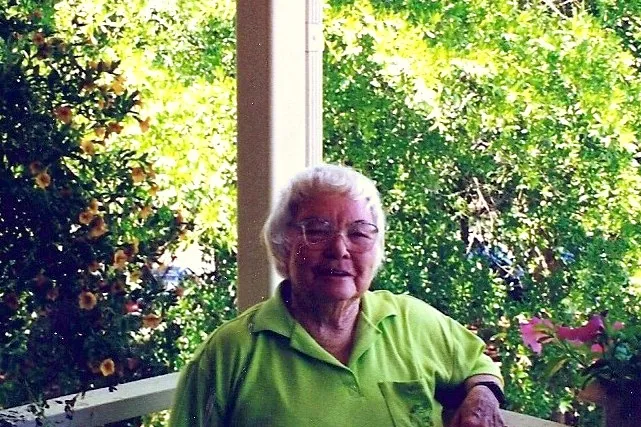
“Grandma was spunky and outgoing, the kind of person who would strike up a conversation with anyone. I visited her in Florida every year and wore the clothes she sewed and knitted for me. Watching Alzheimer's slowly take that away from her has been one of the hardest things my family has been through, and it's a big part of why I'm riding.”
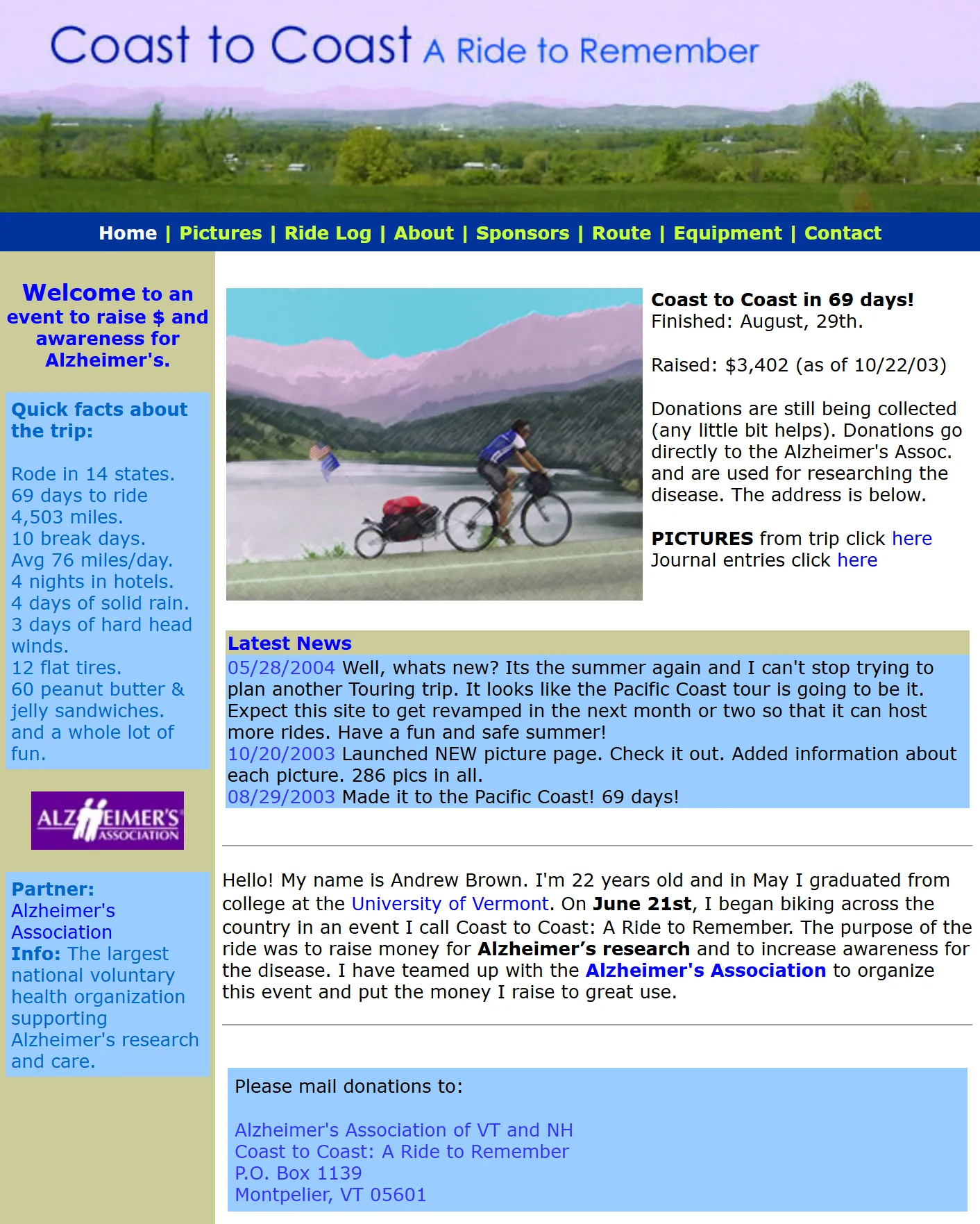
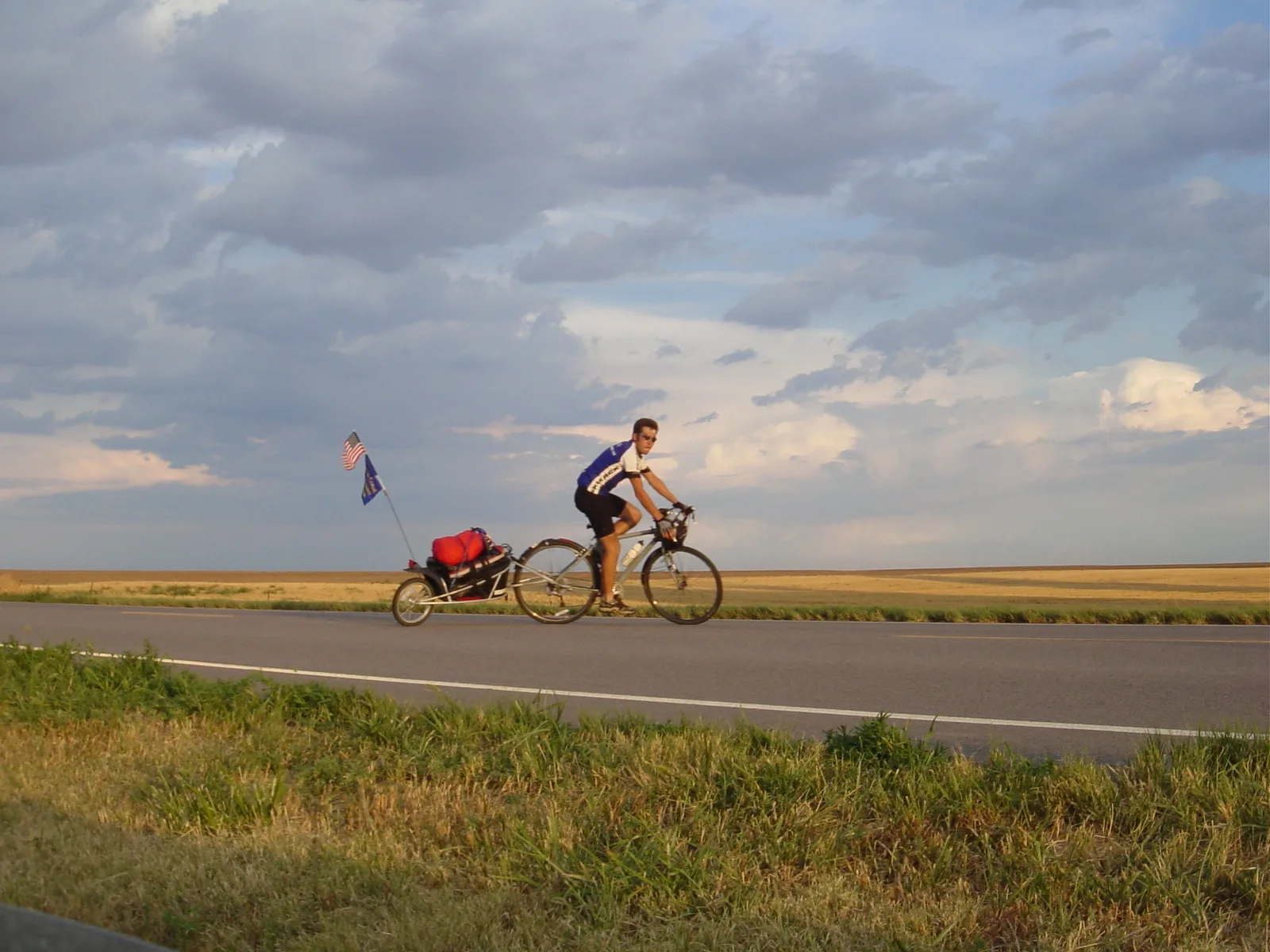
Grandma BrownSo he teamed up with the Alzheimer's Association and put his brand-new computer science degree to work, building his own website to post updates from the road, back when blogs were still a novelty and social networks barely existed. He called the ride Coast to Coast: A Ride to Remember. The plan: dip the back tire in the Atlantic at Portland, Maine, ride to San Francisco, and dip the front tire in the Pacific. Pull everything in a trailer. Camp the whole way. Fly a flag off the back so people would ask what it was about.
He left on June 21, 2003, and reached the Pacific on August 29 — 4,503 miles and 69 days later. The ride raised $3,402 for the Alzheimer's Association, all of it for research.
The route
Adventure Cycling's maps, with one improvisation.
The route was stitched together from the Adventure Cycling Association's cross-country maps: the Northern Tier from Maine through the Adirondacks and along the Great Lakes, then the TransAmerica Trail and its western extension over the Ozarks, the Rockies, Utah's canyon country and the Nevada desert. On paper it came to 4,639 miles.
In Indiana he realized that following the maps all the way to Muscatine, Iowa, would add a lot of miles. So he picked up state road maps of Indiana and Illinois and drew his own line southwest to Murphysboro, Illinois, where he rejoined the official route. The one regret: it meant missing a planned stop at the Alzheimer's Association in Iowa.
Along the way
The people were the trip.
Read the journal and a pattern shows up fast. Strangers paid for breakfast on each of the first two mornings. A farmer in Vermont offered a field to camp in. Two sisters in Boonville, New York, sent him down the road with chicken nuggets, corn dogs and a package of Oreos, then served strawberry shortcake and breakfast. The Arsenault family in Lorain, Ohio, recognized him from the evening news, invited him into their home and promised to keep cooking until he couldn't eat another bite. A man named Roger bought him a rack of championship ribs and lent him a sandbar on the Mississippi.
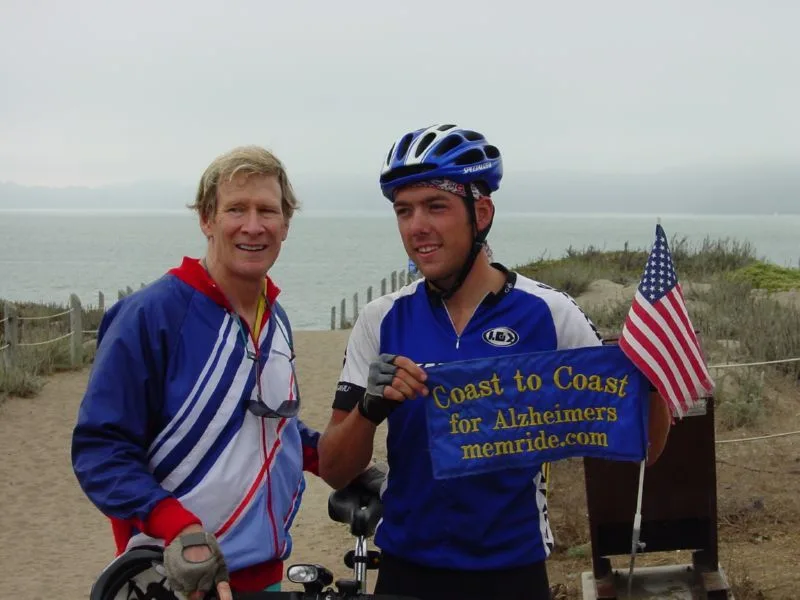
And for the last three miles, he rode alongside Woody — a San Franciscan living with Alzheimer's, who wanted to finish the ride with him.
“The towns I passed through and the people I met are what made this trip so special. There's nothing like seeing the country at 15 miles per hour. You experience it in a way you never could from behind the windshield of a car.”
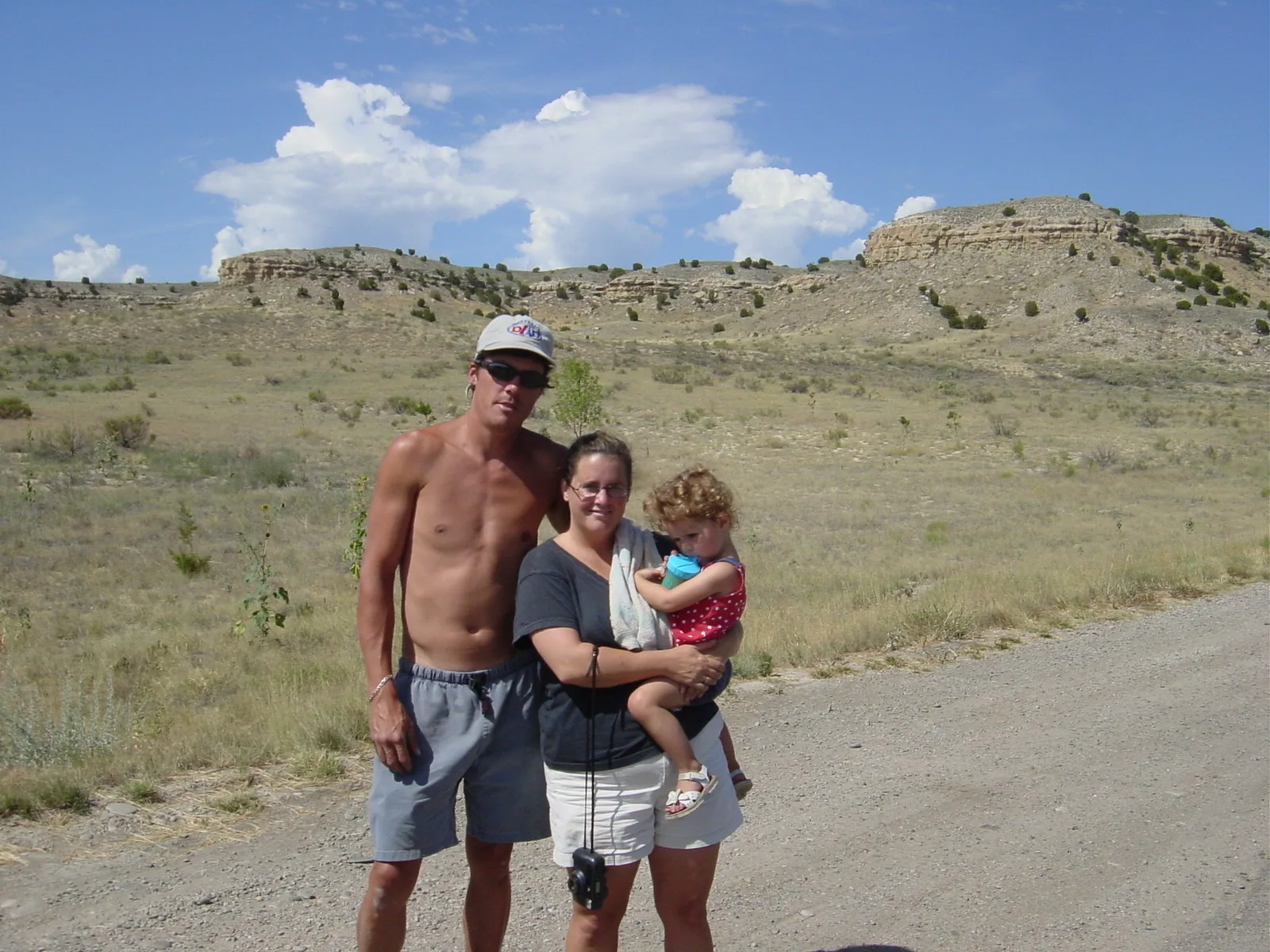
Mission control
The one who worried most, and helped most.
His mom was a nervous wreck about the whole idea, and she became the ride's quiet engine back home anyway. She kept track of every contribution as it came in, clipped and saved every newspaper and magazine story about the ride, and more than once wired money when his wallet ran thin somewhere in the middle of the country.
“I couldn't have finished without her.”
In the news
- Rochester, NYA story in the Democrat and Chronicle and a spot on Channel 10 news while passing through home.
- Cleveland, OHThe six o'clock news — which is how the Arsenault family recognized him at a convenience store and took him in for the night.
- Wichita, KSAn interview with the Wichita Eagle, arranged by the local Alzheimer's Association chapter.
- San Francisco, CAAn ABC News crew waiting on Baker Beach to film the front tire going into the Pacific.
Sponsors & supporters
- Adventure Cycling Associationcreated the route and donated the maps
- SkirackBurlington, Vermont
- Lions Club of SodusSodus, New York
- Sol and Margaret Berger FoundationNew York, New York
- Eagle Ridge AssociatesRochester, New York
- Macinnes Tool CorporationRochester, New York
- Moorseville Race Imagereal NASCAR memorabilia
…and everyone who mailed a check to the Alzheimer's Association of Vermont and New Hampshire with “Coast to Coast” on the memo line.
The cause, today
The ride is over. The need isn't.
Every dollar raised by the ride went directly to the Alzheimer's Association for research. The need hasn't gone away.
About this website
The original memride.com went up before the ride in 2003 and was updated from public libraries during the ride; a photo gallery followed that October. This version, rebuilt more than twenty years later, tells the same story day by day on a map, drawn from those library updates and the captions on the photos. A few overnight stops were never written down and have been pieced together from photo dates — those are marked with an “≈”.